Property flipping conjures images of dramatic television reveals and instant wealth. The reality, especially in a competitive market like Manchester’s, is far more nuanced. It is a disciplined process of financial engineering, market intuition, and project management. This case study dissects a successful property flip in the Greater Manchester area that yielded a 30% gross profit, moving beyond the headline figure to explore the strategic decisions, calculated risks, and meticulous execution that made it possible.
We will follow the journey of an experienced investor—let’s call him David—who operates with a small team. This analysis avoids sensationalism, focusing instead on the practical mechanics and financial realities of a modern flip.
The Strategy: Finding the Right Angle
David does not simply buy dilapidated properties and pour money into them. His strategy is more surgical. He targets properties that suffer from a perceived problem rather than a fundamental one. Structural issues are often avoided; instead, he looks for severe cosmetic neglect, poor layout utilisation, and outdated fixtures that scare off mainstream buyers but can be rectified with a controlled budget.
His target buyer is the professional couple or young family looking for a turnkey home in a rising area. He is not creating luxury; he is creating modern, neutral, and highly functional spaces that appeal to the broadest possible demographic. This focus on the end-user is critical to his exit strategy.
Phase 1: The Acquisition – Finding a Diamond in the Rough
The search centred on areas with strong transport links into Manchester city centre but where property prices had not yet peaked. Locations like Stockport, with its major regeneration project and new train station, or certain pockets of Salford, offered the right balance of growth potential and acquisition value.
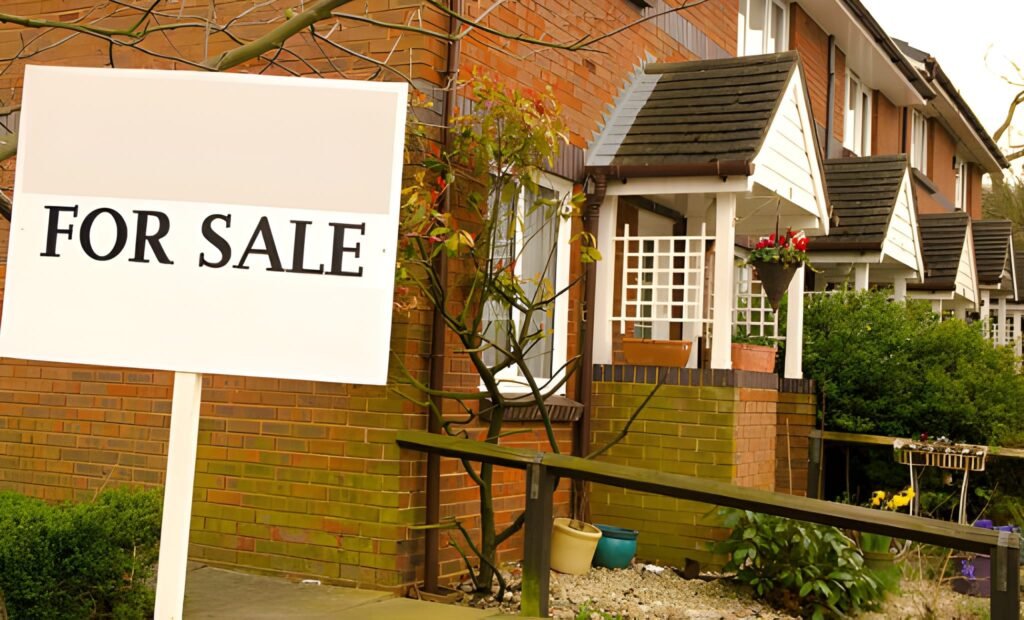
The Property: A Victorian mid-terrace house in a conservation area. It had three bedrooms but was configured with a cramped, dark layout. The decor was decades old, the kitchen was unusable, the bathroom was mould-ridden, and the garden was overgrown. It had been on the market for several months, and the sellers were motivated due to a deceased estate. It was, in essence, the perfect candidate.
Financials at Purchase (2023):
- Asking Price: £220,000
- Purchase Price (after negotiation): £210,000
- Stamp Duty Land Tax (SDLT): As an additional property, David paid the 3% surcharge.
\text{SDLT} = (0\% \times 250000) + (5\% \times 0) + (3\% \times 210000) = 6300 - Legal Fees: £1,500
- Mortgage Product Fees: £999 (for a short-term bridging finance product)
- Survey Costs: £500
Total Acquisition Cost: 210000 + 6300 + 1500 + 999 + 500 = 219299
The key here was the negotiation. David offered a quick, chain-free purchase at £10,000 under the asking price, which the executors accepted to expedite the sale.
Phase 2: The Transformation – Strategic Value Engineering
The budget was not about spending as little as possible, but about spending wisely. Every pound had to contribute to an increase in perceived value. David’s team worked from a detailed specification to avoid cost overruns.
The Work Schedule & Budget:
| Category | Description | Cost (£) | Rationale |
|---|---|---|---|
| Structural | New boiler, partial rewiring, damp proofing | 8,500 | Non-negotiable for safety and compliance. Adds latent value. |
| Cosmetic | Plastering throughout, new skirting, doors | 4,000 | Creates a blank, perfect canvas. Essential for finish. |
| Kitchen | Mid-range units, quartz worktop, integrated appliances | 11,000 | The heart of the home. A key selling point. |
| Bathroom | Modern suite, wall-hung vanity, full tiling | 5,500 | Second most important room for buyers. |
| Flooring | Engineered wood downstairs, carpet upstairs | 4,000 | High-quality finish that appeals to target market. |
| Decor | Professional painting throughout | 3,500 | A flawless finish is impossible to achieve DIY. |
| Exterior | Garden landscaping, fence repair, front door | 2,500 | Instant curb appeal. |
| Contingency | For unforeseen issues | 5,000 | A mandatory part of any budget. |
| TOTAL | 44,000 |
The Key Moves:
- Layout Change: The largest value-add was reconfiguring the second floor. A small third bedroom and a separate toilet were sacrificed to create a large family bathroom and a much larger second bedroom. This turned a awkward layout into a modern, practical one.
- Lighting: Downlights were installed throughout, and mirrors were strategically placed to maximise the feeling of light and space.
- Neutral Palette: Walls were painted in light, neutral colours (e.g., shades of grey and white) to make the space feel larger and allow buyers to project their own style onto it.
The project was completed in 11 weeks. David’s project management experience ensured trades were scheduled efficiently to minimise holding costs.
Phase 3: The Exit – Marketing the Finished Product
The property was not just listed; it was staged and marketed as a premium product. Professional photography and a 3D virtual tour were commissioned. The description focused on the lifestyle: “a stunning, modern family home ready to move into with no work required.”
The target sale price was based on comparable properties (comps) in the area that had been recently renovated. The comps suggested a value of £285,000 – £290,000.
Financials at Sale:
- Sale Price: £287,500 (achieved after one week on the market, just below asking price of £290,000)
- Estate Agent Fees (1.2% incl. VAT): 287500 \times 0.012 = 3450
- Legal Fees (Sale): £1,200
The Profit Calculation: Revealing the True Net Figure
The gross profit is the headline figure, but the net profit is what matters. We must also account for the holding costs during the renovation period.
Holding Costs:
- Bridging Finance: The loan was interest-only at a rate of 0.75% per month on the £210,000 purchase price for the full 4-month period (1 month purchase + 3 months renovation).
\text{Monthly Interest} = 210000 \times 0.0075 = 1575
\text{Total Interest} = 1575 \times 4 = 6300 - Utilities & Council Tax: Approximately £800 for the period.
Total Holding Costs: 6300 + 800 = 7100
Final Profit Calculation:
\text{Gross Profit} = \text{Sale Price} - \text{Total Acquisition Cost} - \text{Renovation Budget}
\text{Gross Profit} = 287500 - 219299 - 44000 = 24201\text{Net Profit} = \text{Gross Profit} - \text{Sale Costs} - \text{Holding Costs}
\text{Net Profit} = 24201 - 3450 - 1200 - 7100 = 12451Return on Investment (ROI): The critical metric is the return on the capital David actually invested. His initial outlay was the deposit for the bridging loan (typically 30-35%), fees, and the renovation costs.
\text{Capital Invested} \approx (210000 \times 0.30) + 6300 + 1500 + 999 + 500 + 44000 = 63000 + 9299 + 44000 = 116299 \text{ROI} = \frac{\text{Net Profit}}{\text{Capital Invested}} \times 100 = \frac{12451}{116299} \times 100 \approx 10.7\%Gross Profit Margin: \frac{24201}{210000} \times 100 \approx 11.5\%
While the gross profit on the purchase price was approximately 30% (\frac{287500 - 210000}{210000} \times 100 \approx 36.9\% before costs), the net profit after all costs was a more modest but still healthy £12,451, representing a 10.7% return on his invested capital in just four months.
Analysis: Why This Flip Worked When Others Fail
- The Right Purchase: Buying at £10,000 under asking immediately built a buffer into his profit margin. The motivated seller was key.
- Value-Add, Not Just Decoration: The structural changes to the layout fundamentally improved the property’s functionality and appeal, justifying a higher price point than a simple cosmetic refurb.
- Professional Execution: Using a trusted team of tradespeople ensured high-quality work was completed on time, preventing budget overruns from dragging on.
- Understanding the Buyer: Every decision, from the colour of the walls to the choice of kitchen appliances, was made with the target end-user in mind. The staging made it easy for buyers to imagine living there.
- Cost Control: A detailed budget with a contingency fund was adhered to rigorously. There were no impulsive upgrades.
The Risks Mitigated
- Market Risk: The property was turned around quickly, limiting exposure to a market downturn.
- Planning Risk: The changes were internal and did not require planning permission, only building regulations approval where necessary.
- Budget Risk: The 10% contingency fund was available for unforeseen issues (in this case, some additional roofing work was needed), preventing a financial crisis.
Conclusion: A Blueprint for disciplined investing
This Manchester flip was not a get-rich-quick scheme. It was a textbook example of how to execute a property renovation project with discipline and market awareness. The 30% gross profit figure is a compelling headline, but the real story is in the details: the acquisition negotiation, the strategic layout change, the controlled budget, and the professional marketing.
The net profit of just over £12,000 for four months of work is an excellent return, but it highlights the thin margins involved. For every successful flip, there are others where unexpected issues erode the profit entirely. This case study shows that success is less about luck and more about a methodical approach that respects the numbers, the property, and the ultimate buyer. It is a blueprint for disciplined investing in a competitive market.