A complete apartment renovation is a profound undertaking that involves stripping a property back to its bare shell and reimagining every element from the floor plan to the final coat of paint. Unlike a single-room update, this is a holistic process of creating a unified, functional, and personalized living environment from scratch. It demands a project-managed approach, where design vision, structural integrity, building regulations, and logistical constraints are balanced with precision. Success is measured not just by the beauty of the finished space, but by the seamless integration of all its systems—electrical, plumbing, heating, and lighting—into a single, cohesive whole that enhances daily life and maximizes the property’s value.
Phase 1: The Foundational Assessment and Strategic Planning
Before any design concept is considered, a period of rigorous assessment and planning is essential. This phase determines the feasibility and scope of the entire project.
The Structural and Regulatory Audit:
The first step is to understand the canvas you are working with. This involves:
- Identifying Load-Bearing Walls: In a multi-story building, you cannot alter structural walls. A structural engineer’s report may be necessary to confirm which walls are safe to remove.
- Assessing Existing Services: The age and condition of the plumbing, electrical wiring, and heating systems must be evaluated. In a complete renovation, it is almost always cost-effective to replace all services, ensuring safety and compliance with current regulations for decades to come.
- Understanding Building Regulations and Covenants: Apartment renovations are governed by strict rules. You must comply with Building Regulations (Part P for electrical work, Part L for energy efficiency) and may also be bound by a leasehold agreement that requires freeholder consent for significant alterations, especially those affecting shared services or the building’s exterior.
Defining the Vision and Budget:
With the constraints understood, you can define your vision. What is the primary goal? To create an open-plan living space, add a bedroom, or maximize storage in a compact footprint? This vision informs the budget. A realistic budget for a complete, high-quality apartment renovation in the UK typically starts at a minimum of £30,000 for a one-bedroom and can easily exceed £75,000 for larger properties or those requiring complex structural work.
A strategic budget allocation should be:
- Labour & Professional Fees: 40-50%
- Materials & Finishes (kitchen, bathroom, flooring): 30-40%
- Contingency Fund: 10-15%
Phase 2: The Design and Spatial Reconfiguration
This is the creative core of the project, where the new layout is conceived.
The Power of a Intelligent Floor Plan:
The most transformative aspect of a full renovation is the ability to reconfigure the space. The goal is to create a logical flow that aligns with your lifestyle. Key strategies include:
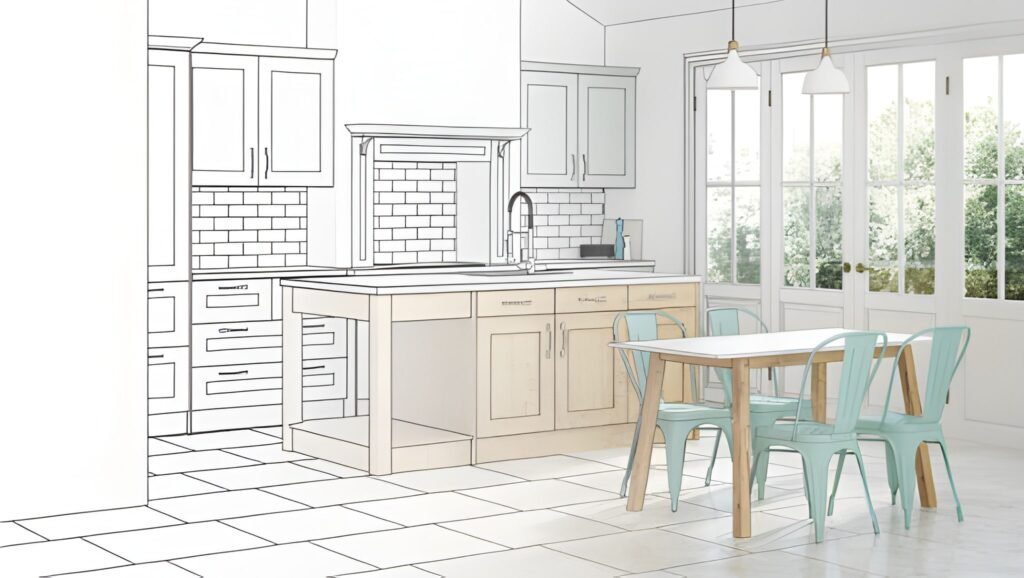
- Creating an Open-Plan Living Area: Removing non-structural walls between the kitchen, living, and dining rooms to create a sense of space and light is the most common and impactful change.
- Zoning with Purpose: Even in an open-plan space, use changes in flooring, ceiling height, or lighting to subtly define different areas without building full walls.
- Re-evaluating Bedrooms and Storage: Can a poorly configured second bedroom be better used as a walk-in wardrobe and study? Can wasted corridor space be reclaimed for built-in storage?
The Cohesive Design Language:
A complete renovation allows for a consistent material and colour palette to flow throughout the entire apartment. This creates a sense of harmony and sophistication. Select a limited palette of two or three core materials—for example, engineered oak flooring, a specific shade of white for walls, and brushed brass for hardware—and use them consistently in different applications.
Phase 3: The Execution – A Phased Approach
The construction must follow a meticulous sequence to ensure efficiency and quality.
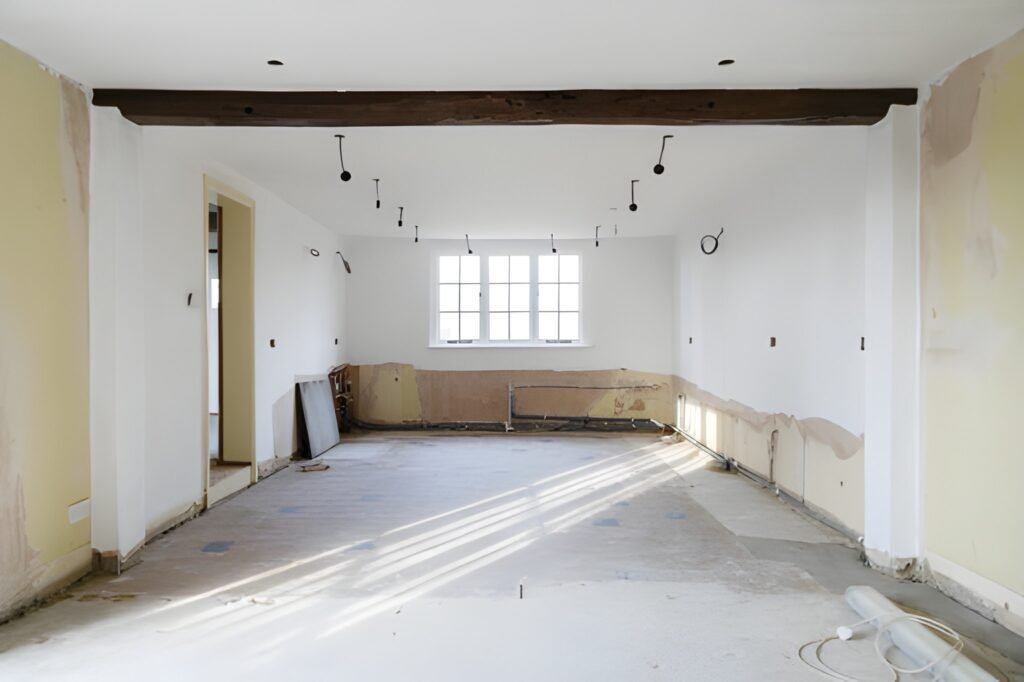
- Strip-Out and Demolition: The apartment is completely emptied and all non-structural elements are removed, revealing the shell.
- First Fix: This is the “guts” of the renovation. All new plumbing, electrical wiring, and data cables are installed within the walls and floors. This is also the stage for any structural work, such as installing steel beams for new openings.
- Plastering and Floor Screeding: Walls and ceilings are plastered to a smooth finish. Underfloor heating systems are laid and covered with a level screed.
- Second Fix: The “visible” infrastructure is installed. This includes hanging doors, fitting skirting boards, installing bathrooms and kitchens, mounting light fixtures, and fitting sockets and switches.
- Decoration and Flooring: Walls are painted, and final floor coverings (e.g., engineered wood, luxury vinyl tile, carpet) are installed.
- Snagging and Final Clean: A meticulous review is conducted to identify and rectify any minor defects, followed by a professional deep clean.
Phase 4: Integrating Systems for a Modern Home
A truly complete renovation future-proofs the property with integrated systems.
- The Lighting Scheme: Move beyond a single ceiling light. Implement a layered plan with ambient (recessed downlights), task (under-cabinet strips), and accent (pendants, wall lights) lighting, all controlled by dimmers.
- Smart Home Infrastructure: Plan for technology. This can be as simple as ensuring strong Wi-Fi coverage and adding smart thermostats, or as advanced as pre-wiring for built-in speakers and smart lighting controls.
- Heating and Ventilation: Underfloor heating provides luxurious, even warmth. A Mechanical Ventilation with Heat Recovery (MVHR) system, while an investment, provides constant fresh, filtered air and recovers heat, making the apartment incredibly energy-efficient and condensation-free.
A complete apartment renovation is a significant journey that requires vision, patience, and expert guidance. When executed with strategic planning and a focus on quality, it results in more than just a updated interior; it creates a deeply personalized, efficient, and resilient home that is a joy to live in and a sound financial investment for the future. It is the process of transforming a generic space into a perfect reflection of its occupant.