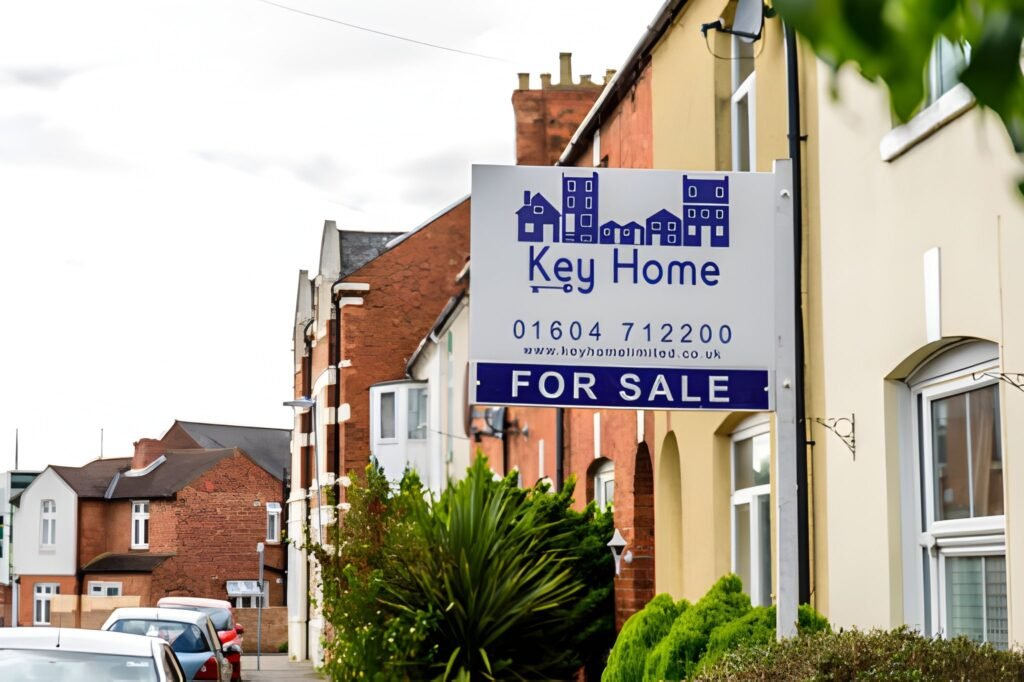
The process, particularly in the nuanced UK market, is fraught with potential missteps that can cost you time, money, and a great deal of stress. A successful sale hinges not just on the property itself, but on the strategy and execution behind its marketing. This guide details the nine most common and costly mistakes vendors make, providing you with the insight to navigate your sale with confidence and achieve the best possible outcome.
Mistake 1: Setting an Unrealistic Asking Price
The single most critical decision you will make is setting the asking price. Get it wrong, and the consequences echo throughout the entire sales process. Many vendors make the mistake of pricing based on emotion, attachment, or the amount they need to secure their next purchase, rather than cold, hard market data.
An inflated price acts as a powerful deterrent. Serious buyers, and their agents, are highly informed. They know the market value of properties in your area. An overpriced home will be overlooked, stagnate on the market, and become stigmatised—potential buyers will assume there is something wrong with it or that the vendor is unreasonable. Eventually, you will be forced to make a series of price reductions, which can look desperate and lead to lower offers than if you had priced correctly from the outset.
How to Avoid This Mistake:
- Instruct Multiple Valuations: Do not rely on the opinion of a single estate agent. Invite three local agents to provide a market appraisal. A good agent will present a detailed Comparable Market Analysis (CMA), showing you what similar properties have actually sold for (not just what they were listed for) recently.
- Understand the Difference: The asking price is an opening gambit. The market value is what a willing and able buyer will actually pay on the day you complete. Your goal is to align these two figures as closely as possible.
- Consider an Independent RICS Surveyor: For a truly unbiased opinion, especially for unique or high-value properties, a chartered surveyor can provide a valuation report.
Example Calculation: The Cost of Overpricing
Assume the true market value of your home is \text{\£400,000}. You list it at \text{\£435,000}. It sits unsold for 12 weeks. You then reduce it to \text{\£415,000}, and finally to \text{\£400,000}. A buyer, seeing the reductions, offers \text{\£390,000}, which you feel pressured to accept.
The direct financial loss is \text{\£400,000} - \text{\£390,000} = \text{\£10,000}. Furthermore, you have incurred additional mortgage payments, council tax, and utility bills for the extra three months the property was unsold. If your monthly outgoings were \text{\£1,200}, that’s another 3 \times \text{\£1,200} = \text{\£3,600} lost.
Total Loss: \text{\£10,000} + \text{\£3,600} = \text{\£13,600}.
Mistake 2: Choosing the Wrong Estate Agent
The estate agent is your quarterback; their competence directly determines the success of your sale. The biggest mistake is choosing an agent based solely on who quotes the highest asking price or the lowest fee. A high quote is often a tactic to win your instruction, and the cheapest agent may provide a service to match.
How to Avoid This Mistake:
- Research and Reputation: Look for well-established agents with a strong presence in your specific locale. Read reviews on Google and Trustpilot. Ask them for their recent success rate (percentage of asking price achieved) and average time to sell.
- Interview Them: How did they conduct the valuation? Did they listen to you? Did they provide a clear marketing plan? A good agent will ask probing questions about your property and your motivations.
- Understand the Contract: Scrutinise the Terms of Business. Key things to look for are:
- Length of Contract: Avoid a tie-in longer than 12-16 weeks.
- Sole vs. Multi-Agency: Sole agency gives one agent the exclusive right to sell, typically for a lower fee. Multi-agency involves multiple agents, and you only pay the one who finds the buyer, but fees are significantly higher. For most properties, a good sole agent is the most cost-effective choice.
- Fee Structure: Know exactly what the percentage fee includes (e.g., is VAT included? Are marketing costs extra?).
Mistake 3: Neglecting First Impressions and Presentation
You are not just selling bricks and mortar; you are selling a lifestyle and an aspiration. Buyers make subconscious judgments within seconds of viewing a property online and in person. A cluttered, poorly maintained, or dirty home suggests hidden problems and forces buyers to use their imagination to see past the mess—many will simply not bother.
How to Avoid This Mistake:
- The Exterior (Kerbside Appeal): Ensure the front garden is tidy, the path is clean, the front door is freshly painted, and the house number is clear. This is the first physical thing a buyer sees.
- Declutter and Depersonalise: Remove excess furniture to make spaces feel larger. Pack away family photos, religious items, and trophies. This allows buyers to visualise themselves living in the space.
- Deep Clean: Every surface must be spotless. Clean windows, steam clean carpets, address any lingering odours (pet, smoke, damp, cooking).
- Consider Professional Staging: For vacant properties, or those that need help, professional staging with hired furniture and art can make a dramatic difference in how a property photographs and shows, often justifying the investment through a higher sale price.
Mistake 4: Ineffective Marketing and Poor Photography
In the digital age, your property’s online listing is its shop window. Over 95% of buyers start their search online. Blurry, dark, or poorly composed photographs taken on a mobile phone will cause potential buyers to scroll straight past your listing.
How to Avoid This Mistake:
- Insist on Professional Photography: A good agent will always use a professional photographer. This is non-negotiable. This includes high-resolution wide-angle photos, and often twilight shots for the exterior.
- Demand High-Quality Floorplans: A floorplan is essential. It helps buyers understand the flow of the property and confirms room sizes. Its absence is a significant disadvantage.
- Utilise Video and Virtual Tours: A well-produced video tour or 360-degree virtual tour significantly increases engagement and allows more serious buyers to self-qualify before booking a viewing.
- Check the Copy: The property description should be well-written, accurate, and highlight key features and the local area’s benefits without resorting to clichés.
Mistake 5: Being Unprepared for the Legal Process
The legal conveyancing process in England and Wales is notoriously complex and can be slow. A common mistake is to instruct a solicitor only after accepting an offer, which causes immediate delay. The savvy vendor instructs a solicitor early and has them begin gathering the necessary paperwork.
How to Avoid This Mistake:
- Instruct a Solicitor Early: Contact your chosen conveyancer as soon as you decide to sell. They can send you the initial forms to complete.
- Gather Your Documents: Locate your title deeds, Energy Performance Certificate (EPC), guarantees for windows, roofs, or damp-proof courses, and any planning permission or building regulations certificates for work you have had done. Having this to hand will dramatically speed things up once a buyer is found.
- Choose Your Conveyancer Wisely: Do not automatically choose the cheapest quote. Opt for a firm with good communication skills. Conveyancing factories can be slow and unresponsive. A local solicitor or a dedicated, recommended conveyancer is often worth the extra cost.
Mistake 6: Hiding Major Problems
It is legally and ethically imperative to disclose any known material information about the property’s condition. Attempting to hide significant issues like subsidence, significant damp, structural problems, or a troublesome neighbour is a catastrophic error. The buyer’s survey will almost certainly uncover it, derailing the sale and potentially leaving you open to legal action for misrepresentation.
How to Avoid This Mistake:
- Complete the Property Information Form (TA6) Honestly: This comprehensive form asks direct questions about the property. You must answer these truthfully and to the best of your knowledge.
- Be Proactive: If you are aware of a problem, consider obtaining quotes for repair. Presenting these to a potential buyer demonstrates honesty and allows them to factor the cost into their offer, potentially saving the negotiation.
Mistake 7: Being Emotionally Involved During Negotiations
Your home is full of memories, but during a sale, it becomes a commodity. Taking negotiations personally is a dangerous mistake. A buyer’s offer is a business proposition, not a personal insult. Becoming defensive or emotional over a low offer can kill a deal before it has a chance to develop.
How to Avoid This Mistake:
- Let Your Agent Act as a Buffer: Your estate agent is trained in negotiation. Use them. They can communicate with the buyer’s agent objectively, without emotion clouding their judgment.
- See the Whole Chain: Evaluate an offer on its merits. Is the buyer chain-free? Are they mortgage-approved? A slightly lower offer from a highly proceedable buyer is often worth far more than a higher offer from someone in a long, fragile chain.
- Negotiate on Terms, Not Just Price: If the offer is below your expectation, consider other points. Can you negotiate on the inclusion of fixtures and fittings? Can you agree on a completion date that suits you both?
Mistake 8: Failing to Understand the Buyer’s Chain
In England and Wales, most property purchases are part of a “chain”—a sequence of linked transactions where each buyer is also a seller. The strength and length of this chain is a primary determinant of how smoothly your sale will proceed. Ignoring the status of your buyer’s position is a recipe for frustration.
How to Avoid This Mistake:
- Establish “Proceedability”: Your estate agent must rigorously qualify any potential buyer. Key questions to ask:
- Do you have a property to sell? If so, is it under offer?
- Are you a first-time buyer (chain-free)?
- Do you have a mortgage Agreement in Principle?
- Have you instructed a solicitor?
- Prioritise Secure Buyers: A chain-free buyer or one whose property is already sold subject to contract is inherently less risky than someone just beginning their marketing process. This information should heavily influence which offer you accept.
Mistake 9: Not Planning Your Own Move in Advance
The process from offer to completion can be unpredictable. Failing to plan your own move until the last minute creates immense stress and can cause you to pressure your solicitor to exchange before they are ready, potentially leading to mistakes.
How to Avoid This Mistake:
- Research Removals Early: Get quotes from several removal firms. You can often book a provisional date with a few weeks’ notice.
- Start Packing Non-Essentials: Begin packing items you won’t need immediately (e.g., seasonal clothing, books, decorative items). This makes the final move much quicker.
- Have a Contingency Plan: Know what you will do if there is a gap between completion on your sale and your purchase. Can you stay with family? Is temporary accommodation an option? Having a plan reduces panic.
Summary Table: Mistakes and Mitigations
| Mistake | Likely Consequence | How to Mitigate |
|---|---|---|
| Unrealistic Asking Price | Stagnation, price reductions, lower final offer. | Obtain multiple agent valuations and a CMA. |
| Choosing the Wrong Agent | Poor marketing, weak negotiation, slow sale. | Research reputation, interview agents, read the contract. |
| Poor Presentation | Buyers can’t visualise themselves living there; lower offers. | Declutter, depersonalise, deep clean, enhance kerb appeal. |
| Ineffective Marketing | Low viewings, lack of serious interest. | Insist on professional photos, floorplans, and a virtual tour. |
| Unprepared for Legals | Delays, sale falling through, added stress. | Instruct a solicitor early and gather all documents. |
| Hiding Problems | Sale collapsing, legal action for misrepresentation. | Disclose all issues honestly on the TA6 form. |
| Emotional Negotiation | Offending buyers, losing a good offer. | Use your agent as a buffer; evaluate the whole offer. |
| Ignoring the Buyer’s Chain | A long, unstable, and collapsing chain. | Qualify buyers rigorously on their proceedability. |
| Poor Move Planning | Last-minute chaos, stress, and extra cost. | Research removals early; pack in advance; have a plan B. |
Selling a home will never be entirely stress-free, but by understanding and avoiding these nine common mistakes, you take control of the process. You shift the odds dramatically in your favour, maximising your chances of achieving a successful, timely, and profitable sale. Prepare thoroughly, act strategically, and rely on expert advice to guide you through one of life’s most significant transactions.