The 21st-century eco-friendly home represents a fundamental shift in our relationship with shelter. It has moved beyond a simple checklist of green features—a solar panel here, a rainwater tank there—and matured into a holistic, integrated philosophy. This modern dwelling is a dynamic system, a living organism that is deeply connected to its environment, its community, and the data it generates. It is not just built sustainably; it operates intelligently, promotes occupant wellbeing, and is designed for a circular future from its very foundations. This blueprint explores the core principles, technologies, and designs that define this new standard for regenerative living.
The Core Philosophy: From Green Add-ons to Systemic Integration
The defining characteristic of the 21st-century eco-home is its decisive shift from a fragmented to a systemic approach. Where 20th-century thinking might have involved retrofitting insulation or adding renewables to a conventional design, the contemporary model starts with a unified vision. The home is a single, coordinated entity where the building fabric, energy systems, water management, and digital intelligence are designed from the outset to work in concert. This is the “Fabric First” principle executed with technological sophistication. The ultimate goal is a net-positive building: one that generates more energy than it consumes, captures and cleans more water than it uses, improves air quality, and enhances the health of its inhabitants and the local ecosystem.
The Intelligent and Responsive Envelope
The boundary between inside and outside is no longer a static barrier but a dynamic, responsive membrane designed for optimal performance.
- Bioclimatic Design: The home’s orientation, form, and window placement are precisely calculated using solar path analysis and climate data. A long, thin east-west axis maximizes southern exposure for passive solar gain in the Northern Hemisphere. Strategic landscaping and earth berming on the north side provide natural windbreaks and insulation. Deep overhangs or brise-soleil are calculated for the site’s specific latitude, shading the high summer sun while inviting the low winter sun to penetrate and provide free heating.
- Advanced Insulation and Airtightness: Performance goes beyond simply adding thick insulation. The modern home uses smart materials and meticulous detailing. Airtightness membranes are installed with forensic precision, and blower door tests verify performance, targeting air permeability rates below 3.0 m³/(h·m²) at 50Pa, far exceeding standard building regulations. Materials like hempcrete, cork, and wood fibre board are chosen not only for their insulating properties but for their ability to manage humidity and their low embodied carbon.
- Dynamic Glazing and Shading: Triple glazing with low-emissivity coatings and argon gas fills is the baseline. The innovation lies in dynamic systems: electrochromic glass that tints electronically to control solar gain and glare, or computer-controlled external louvres that automatically adjust throughout the day to optimize light and temperature, significantly reducing mechanical cooling loads.
Energy Systems: Generation, Storage, and Intelligent Management
The 21st-century home functions as a personal, intelligent power station, moving from mere efficiency to active energy independence.
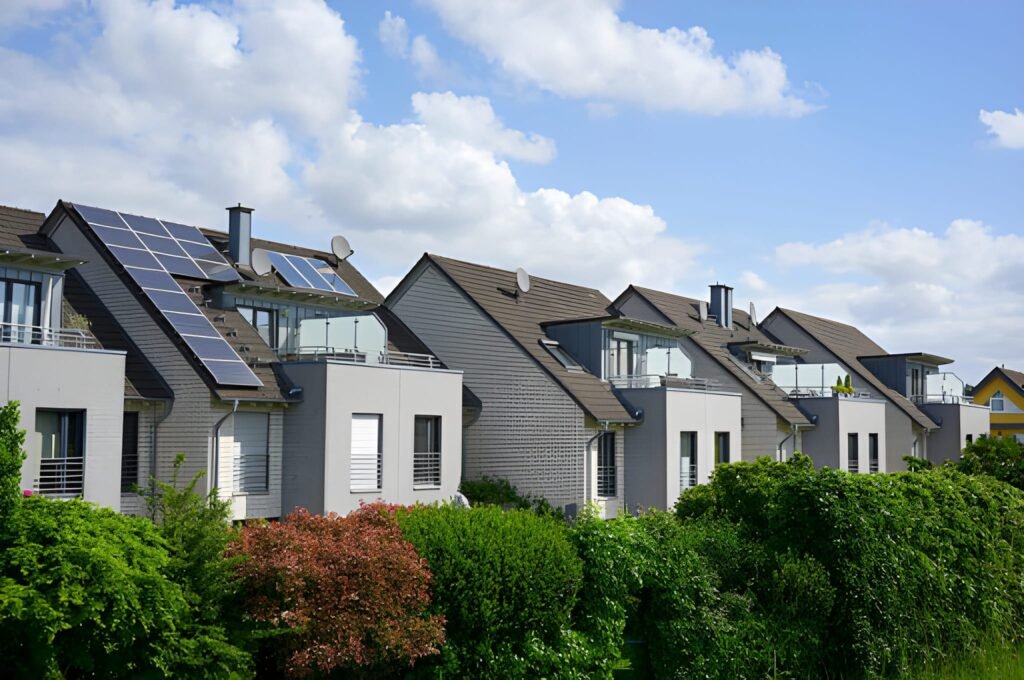
- Renewable Generation: Building-Integrated Photovoltaics (BIPV), such as solar tiles and slates, have replaced bulky panels, creating a seamless aesthetic. For suitable sites, a small, quiet vertical-axis wind turbine can complement solar generation, providing power during winter months. Ground-source or air-source heat pumps provide highly efficient, low-carbon heating and cooling.
- Integrated Storage: The key to energy independence is storage. Lithium-ion or emerging solid-state battery walls store excess solar energy for use at night. A more advanced concept is the heat battery, which stores electricity as thermal energy in materials like phase-change salts or vermiculite, providing hot water and space heating on demand.
- The Home Energy Management System (HEMS): This is the home’s digital brain. The HEMS is an AI-driven platform that connects to all major appliances, the battery, the EV charger, and the national grid. It learns the household’s patterns and automatically optimises energy flow. It decides to run the dishwasher or charge the car when solar production is at its peak, sells excess power back to the grid during times of high demand, and draws power from the grid when it is cheapest and greenest, all while maximizing self-consumption.
Water and Waste: Closing the Loop
The modern home views water as a precious resource to be harvested, purified, and reused in a closed-loop system, mimicking natural hydrological cycles.
- Rainwater Harvesting + Filtration: Collected rainwater is not just for the garden. It is filtered through a multi-stage process, including sediment filters and UV sterilization, to potable standards for all non-potable uses: toilet flushing, laundry, and even showering.
- Greywater and Blackwater Recycling: Sophisticated systems treat all water on-site. Lightly used greywater from showers and sinks is filtered and reused for irrigation or toilet flushing. Compact, aerobic bioreactors (such as membrane bioreactors) or passive constructed wetland systems can treat blackwater, turning waste into clean effluent for garden irrigation and nutrient-rich compost, effectively closing the nutrient loop.
- Permeable Landscaping and SuDS: Hard surfaces are minimized. Driveways and paths use permeable paving or gravel to allow rainwater to replenish the aquifer naturally. Sustainable Drainage Systems (SuDS), such as rain gardens and swales, manage runoff, reduce flood risk, and create habitats.
Health, Wellbeing, and Biophilic Design
The 21st-century home recognizes that occupant health is as important as planetary health, creating environments that actively support physical and mental wellbeing.
- Superior Indoor Air Quality (IAQ): A Mechanical Ventilation with Heat Recovery (MVHR) system is fundamental. It provides a constant supply of fresh, filtered air, removing pollutants, allergens, and excess humidity while retaining up to 95% of the heat from the extracted stale air. Low-VOC paints, plasters, and natural materials like solid wood, stone, and clay prevent the off-gassing of harmful chemicals.
- Biophilic Design: This principle, which asserts that humans have an innate connection to nature, is central to the design. The home actively incorporates natural elements through abundant natural light, cross-ventilation, views of greenery, and the use of natural materials and textures. A living wall indoors or a central courtyard garden blurs the line between inside and out, reducing stress and improving cognitive function.
- Acoustic Comfort: Attention is paid to soundscapes. Mass walls, acoustic insulation under floors, and soft furnishings create a quiet, serene environment that serves as a sanctuary from a noisy world.
The Digital Layer: Data, Connectivity, and the Circular Economy
Technology serves the home’s ecological goals, creating a responsive and adaptable living system.
- Integrated Sensor Networks: A network of sensors continuously monitors temperature, humidity, CO2 levels, VOC levels, water usage, and energy consumption. This data feeds the HEMS and other building management systems, allowing for real-time adjustments for optimal comfort, health, and efficiency.
- Circular Economy and Material Passports: The home is designed for disassembly and adaptability. A digital “material passport” catalogues every component—specifying its source, chemical composition, and how it can be reused, recycled, or composted. This eliminates the concept of waste and turns the building into a “bank of materials” for the future, ensuring resources remain in circulation.
A 21st-Century Home Profile: The Net-Positive Urban Retrofit
To illustrate these principles in action, consider a three-bedroom Victorian terraced house in London, retrofitted to 21st-century standards.
- Fabric Upgrade: The solid brick walls receive 150mm of internal wood fibre insulation, bringing the U-value down to approximately 0.25 W/m²K. The roof is insulated to 400mm with cellulose insulation. New triple-glazed timber-aluminium composite windows (U-value of 0.8 W/m²K) are installed. Airtightness is meticulously improved to 2.0 m³/(h·m²).
- Systems: A 6 kWp solar tile array covers the south-facing roof. A 10 kWh lithium-ion battery is installed in the basement. An Air Source Heat Pump with a Coefficient of Performance (COP) of 3.5 provides all heating and hot water. A whole-house MVHR system with an efficiency of 90% runs constantly.
- Water: A 2,000-litre underground tank collects rainwater for all toilet flushing and garden use. All taps and showers are fitted with high-performance aerators.
- Intelligence and Outcome: A HEMS platform manages the entire system. The annual energy demand is calculated. The solar array generates an estimated 6\ \text{kWp} \times 850\ \text{kWh/kWp} = 5,100\ \text{kWh} per year. The combination of super-insulation and efficient systems reduces the home’s annual energy consumption to 4,500 kWh. The result is an annual energy bill of zero, with the Smart Export Guarantee generating an income from the exported surplus.
The 21st-century eco-friendly home is therefore a quiet revolution in design and living. It is resilient, comfortable, healthy, and economically advantageous. It represents a new contract between the individual and the planet—one of mutual support and regeneration, enabled by intelligence, thoughtful design, and a profound respect for the resources it uses. It is not a distant fantasy but a viable, necessary blueprint for the future of housing.