The sustainable tiny home movement represents a fundamental shift in how we conceive of space, ownership, and our environmental footprint. More than just a small house, it is a carefully considered system that prioritises efficiency, quality, and ecological harmony. For those feeling the pressures of the UK’s housing market, environmental concerns, and a culture of consumption, the tiny home offers a compelling alternative—a way to live lightly on the earth without sacrificing comfort or design intelligence.
The Core Philosophy: Why Small is Inherently Sustainable
The most powerful sustainable feature of a tiny home is its size. A reduced physical footprint is the genesis of every environmental benefit that follows. A smaller building requires fewer materials to construct, less energy to heat and cool, and minimal resources to maintain. This principle of sufficiency—using only what is needed—challenges the paradigm of ever-larger homes and their associated resource demands.
This lifestyle necessitates a conscious curation of possessions, which in turn reduces consumption and waste. The limited space forces a clarity of purpose, encouraging owners to invest in high-quality, multi-functional, and durable items rather than accumulating disposable goods. The psychological shift is as significant as the physical one, moving from a mindset of more to one of better.
Design Principles for Maximum Efficiency and Comfort
Creating a successful sustainable tiny home requires meticulous planning where every square inch serves a purpose.
- The Multi-Functional Core: Rooms do not exist as single-purpose entities. Furniture must be adaptable. A dining table folds away or transforms into a workspace. Stairs integrate deep drawers for storage. Sofas convert into guest beds. This approach eliminates wasted space and ensures every element works hard for its place.
- Vertical Space Utilisation: With a limited footprint, the vertical dimension becomes critical. High ceilings with lofted sleeping areas, tall shelving, and hanging storage for kitchenware and bikes maximise the available volume, preventing the interior from feeling cramped.
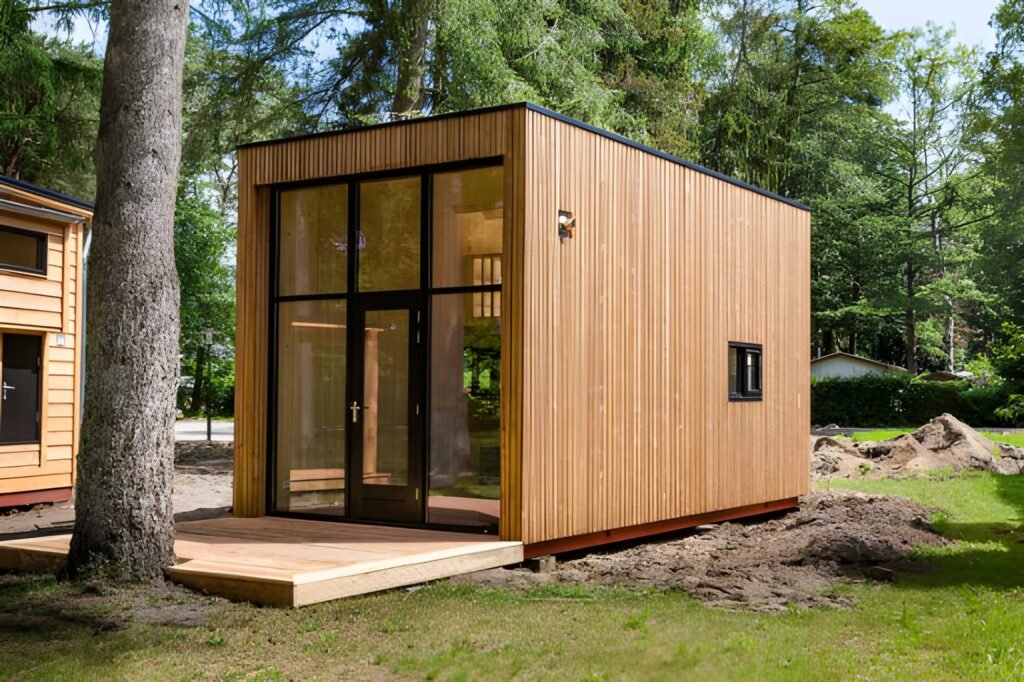
- Strategic Connection to the Outdoors: A tiny home feels larger when it is visually connected to its surroundings. Large, well-placed windows and glass doors blur the boundary between inside and out, making the garden or natural landscape an extension of the living space. A covered deck or patio effectively becomes an additional room for much of the year.
- Passive Solar Design: Orienting the home to capture the low winter sun through south-facing glazing provides free heating. Properly calculated roof overhangs shade these same windows during the high summer sun, preventing overheating. This passive approach drastically reduces the need for mechanical heating and cooling.
Building Materials: Selecting for Low Embodied Carbon and Health
The choice of materials defines the home’s ecological footprint and its internal air quality.
- The Structural Shell: While steel shipping containers offer a recycled narrative, they require significant insulation to overcome thermal bridging. Timber framing remains a popular, renewable, and highly insulative option, especially when sourced from FSC-certified forests. Structural Insulated Panels (SIPs) provide an excellent, airtight shell that goes up quickly, reducing construction time and waste.
- Natural Insulation: The small volume of a tiny home makes superior insulation affordable. Beyond fibreglass, options like sheep’s wool (excellent moisture regulation), wood fibre board (vapour-permeable and stable), hempcrete (carbon-negative), and recycled denim offer high performance with low environmental impact and safe installation.
- Non-Toxic Interiors: In a compact, airtight space, indoor air quality is paramount. Walls should be finished with clay or lime plasters instead of gypsum, which can harbour mould. All paints, sealants, and adhesives should be zero or low-VOC (Volatile Organic Compounds). Flooring of solid timber, cork, or linoleum is durable and free from the off-gassing common in synthetic laminates.
Energy, Water, and Waste Systems for Self-Reliance
A tiny home’s small scale makes it an ideal candidate for off-grid or light-touch grid living.
- Energy Generation and Storage: A modest solar photovoltaic (PV) array, often between 2-4 kWp, can meet most electrical needs. The key is pairing it with a battery system, such as a 5-10 kWh lithium-ion battery, to store solar power for use at night. For heating, a small air-source heat pump or highly efficient electric radiators powered by the solar array is the cleanest choice. A wood-burning stove can be a carbon-neutral backup, but its particulate emissions are a consideration.
- Intelligent Ventilation: An airtight tiny home requires mechanical ventilation. A single-room or small multi-room Mechanical Ventilation with Heat Recovery (MVHR) unit is the ideal solution. It continuously extracts stale, moist air from the kitchen and bathroom and supplies fresh, filtered air to living spaces, recovering up to 90% of the heat in the process. This prevents condensation and ensures a constant supply of clean air.
- Water Conservation and Management:
- Consumption: All fixtures should be low-flow. A 6-litre/minute showerhead and aerated taps are standard. A small, on-demand electric water heater avoids the energy loss of storing hot water.
- Rainwater Harvesting: A single 1,000-litre tank can supply all non-potable water for toilet flushing, laundry, and the garden. A simple filtration system makes it suitable for showers as well.
- Wastewater: Composing toilets, which require no water and turn waste into safe compost, are a mainstream option for tiny homes. For greywater from sinks and showers, a compact constructed wetland or a filtration system can clean the water for garden use.
The UK Context: Planning, Finance, and Practicalities
Navigating the legal and financial landscape is a critical part of the process.
- Planning Permission: The situation is nuanced. A tiny home on a permanent foundation is treated as a new dwelling and requires full planning permission. However, a tiny home on wheels may be classified as a caravan or mobile home. This often falls under “permitted development” on private land, but you cannot typically use it as a sole permanent residence without a change of use permission. Local Authority discretion is significant, and pre-application advice is essential.
- Financing and Insurance: Traditional mortgages are not available for mobile tiny homes. Options include personal loans, specialist eco-loans, or self-build mortgages for fixed foundations. Insurance can also be more complex, requiring specialised providers who understand the unique nature and value of the property.
- Costs: A self-built tiny home can cost from £40,000 to £80,000, excluding land. A professionally built, high-specification model can range from £80,000 to £150,000. While the upfront cost per square metre is high, the overall outlay is often a fraction of a conventional house, with drastically lower lifetime running costs.
The Lifestyle Reality: Weighing the Benefits and Challenges
The tiny home life is not an idyllic escape for everyone. It demands adaptability.
- Benefits: Financial freedom from a small or non-existent mortgage; drastically reduced energy and utility bills; a minimalised lifestyle free from clutter; and a deep, tangible connection to one’s immediate environment.
- Challenges: Limited space for entertaining or hobbies; the need for constant organisation; potential storage issues for seasonal items; and the logistical hurdles of finding a legal place to site the home.
The sustainable tiny home is a testament to the idea that living well is not a function of square footage. It is a deliberate choice to optimise one’s life around experiences, relationships, and environmental stewardship, rather than the accumulation of space and possessions. It proves that a small, thoughtfully designed footprint can make a disproportionately large positive impact.