For decades, the approach to managing rainwater from our homes and streets has been one of simple expediency: get it off the property and into a pipe as fast as possible. This “convey and dispose” mentality has shaped our urban landscapes with a hidden network of guttering, downpipes, and sewers. However, the consequences of this outdated approach are becoming impossible to ignore. Increased flooding, river pollution, and the loss of natural green spaces are the direct results of replacing permeable soil with impermeable concrete and tarmac.
Sustainable Drainage Systems, or SuDS, represent a fundamental shift in this philosophy. Instead of viewing rainwater as a waste product to be disposed of, SuDS treat it as a valuable resource. The goal is to manage rainfall close to where it lands, mimicking the natural water cycle by allowing it to soak into the ground, be stored for later use, or be released slowly back into watercourses. This is not a niche environmental concept; it is a practical, engineered set of solutions that are becoming a mandatory part of new housing developments across the UK. This guide demystifies SuDS, explaining their principles, their components, and their vital importance for the future of our communities.
The Core Principles of Sustainable Drainage
SuDS are built upon four key pillars that work in concert. Understanding these principles is more important than memorising any single technical detail, as they guide the entire design process.
The first principle is managing water quantity. Traditional drainage pushes water quickly into overloaded sewers, exacerbating flood risk downstream. SuDS aim to control the rate and volume of surface water runoff. They achieve this through techniques that slow the water down, hold it temporarily, and encourage infiltration into the soil. The objective is to ensure that after a new development is built, the peak flow of water leaving the site after a storm is no greater than it was when the site was in its natural, undeveloped state. This is a radical departure from the old method, which invariably increased runoff.
The second principle is improving water quality. As rainwater flows over roofs, roads, and driveways, it picks up a cocktail of pollutants: oil from cars, heavy metals from brake dust, pesticides from gardens, and organic matter. Traditional systems dump this contaminated water directly into rivers. SuDS incorporate natural processes to clean the water. By passing water through vegetated swales, filter strips, and specially designed soils, these systems filter out silt and pollution. Microbial activity in the soil and uptake by plants break down harmful contaminants, significantly improving the quality of water that eventually reaches groundwater or streams.
The third principle is creating and enhancing biodiversity and amenity. This is where SuDS move beyond mere engineering and into place-making. Instead of hiding drainage in buried pipes, SuDS are often visible, attractive features that can become assets to a community. A retention pond can be a focal point for a neighbourhood, supporting aquatic plants, amphibians, and insects. A swale can be a landscaped green corridor. By providing habitats and connecting green spaces, SuDS contribute directly to local ecological networks and make neighbourhoods more pleasant places to live.
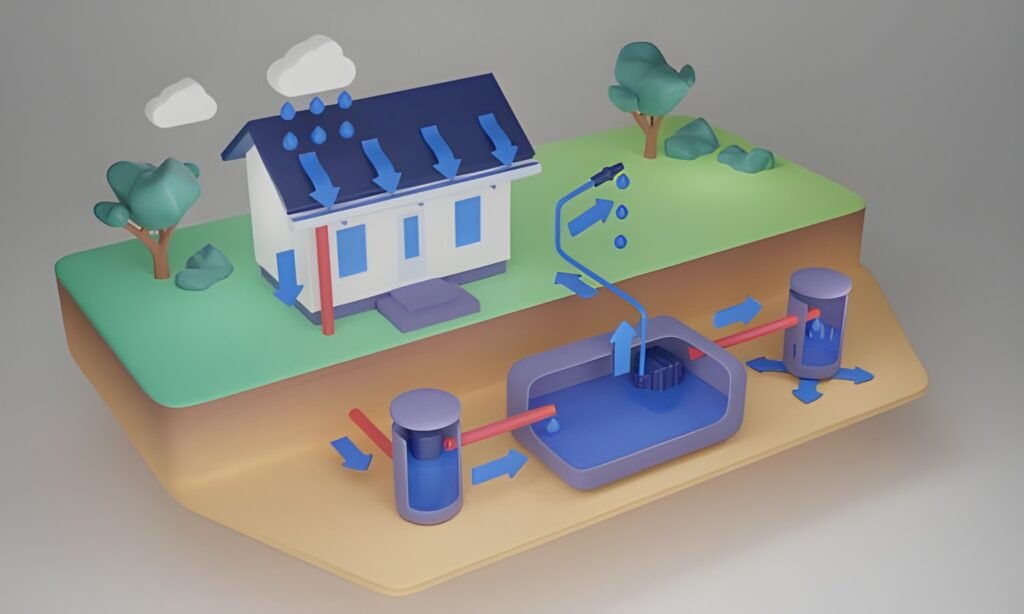
The fourth and often overlooked principle is the management of water as a resource. In an era of increasing water scarcity, it is wasteful to simply channel precious rainwater out to sea. SuDS promote the harvesting and reuse of rainwater. This can be as simple as a water butt connected to a downpipe for garden use, or as integrated as a system that stores large volumes of water underground for non-potable uses like toilet flushing or garden irrigation.
A Toolkit of SuDS Techniques: From Source to Region
SuDS operate at multiple scales, from individual house plots to entire neighbourhoods. The most effective strategies employ a “treatment train”—a series of linked components that manage water step-by-step.
At the source control level, the focus is on individual properties. The simplest technique is the humble water butt. By collecting rainwater from a roof for garden use, it reduces the volume of runoff and provides a free resource. A more advanced form of source control is a green roof, where a layer of vegetation is grown on a roof surface. The plants and soil substrate absorb rainwater, which is then released slowly back into the atmosphere through evapotranspiration. For driveways and paths, using permeable paving is a highly effective solution. Unlike standard asphalt or concrete, permeable surfaces allow water to infiltrate through the gaps between blocks or through the porous material itself, passing into a stone reservoir base below where it is stored and slowly infiltrates into the ground.
The next stage in the treatment train involves site control for areas like a housing estate or a public space. Here, several key components come into play. A swale is a broad, shallow, vegetated channel designed to convey water slowly. Unlike a concrete ditch, a swale allows water to soak into the ground as it travels, and its vegetation filters out pollutants. For areas where space is limited, an infiltration trench might be used. This is a trench filled with gravel that stores surface water runoff, allowing it to percolate slowly into the surrounding soil.
When the goal is to capture and treat larger volumes of water before a slow release, subsurface storage systems are employed. These are often large crates or stone-filled areas buried underground beneath a car park or playing field. They provide the volume control that pipes once did, but without the rapid, polluting discharge.
At the regional scale, these components combine into larger features. A retention or detention pond is a permanent body of water that provides substantial storage capacity and significant water quality and biodiversity benefits. A constructed wetland is a more complex system that uses wetland plants and soils to treat water through a combination of physical, chemical, and biological processes. These larger features often serve as valuable community green spaces.
Comparing Traditional Drainage and SuDS
The differences between the old and new approaches are profound, affecting every aspect of a development’s relationship with water.
| Feature | Traditional Drainage | Sustainable Drainage (SuDS) |
|---|---|---|
| Philosophy | Rapid disposal of water as a waste product. | Management of water as a resource. |
| Primary Pathway | Pipes and culverts (hidden, underground). | Swales, basins, and ponds (visible, integrated). |
| Flood Impact | Increases peak flow, exacerbating flood risk downstream. | Aims to match pre-development runoff rates, reducing flood risk. |
| Water Quality | Transfers pollutants directly to rivers. | Treats and filters pollutants naturally. |
| Biodiversity | Negative impact; severs ecological connections. | Positive impact; creates new habitats and green corridors. |
| Amenity Value | Low; infrastructure is hidden and offers no public benefit. | High; can provide parks, walking trails, and visual amenity. |
| Cost Focus | Capital cost of pipe installation. | Whole-life cost, including maintenance and community value. |
The Regulatory and Planning Context in the UK
In the UK, the drive for SuDS is backed by strong policy. In England, the 2024 implementation of Schedule 3 of the Flood and Water Management Act 2010 mandates that all new developments of more than one house (or over 100 square metres) must have their drainage systems approved by a new national body, the SuDS Approving Body (SAB). The system must comply with mandatory National Standards. This legal framework ensures that SuDS are not an optional extra but a core requirement, assessed for their technical viability, long-term maintenance, and adoption.
In Wales, these regulations have been in place since 2019, making the country a leader in this field. Scotland also has a strong policy framework through the Water Services etc. (Scotland) Act 2005 and the Sewers for Scotland 3rd Edition guidance, which promotes SuDS as the default solution.
For any homeowner or developer, engaging with the local planning authority and the SAB at the earliest possible stage is critical. A well-designed SuDS scheme can be a positive factor in securing planning permission, while a poor or non-existent one can be a reason for refusal.
The Financial Perspective: Costs and Long-Term Value
A common misconception is that SuDS are always more expensive than traditional piped systems. While the upfront capital costs can be comparable or sometimes higher, a whole-life cost analysis often reveals a different picture. The true cost of drainage includes not just construction but also maintenance, replacement, and the wider societal costs of flooding and pollution.
Consider a simple financial comparison for a small 10-house development.
Option A: Traditional Piped Drainage
- Construction Cost: £40,000
- 25-Year Maintenance (jetting, repairs): £15,000
- Total Estimated Cost: £55,000
Option B: SuDS with Swale and Infiltration Basin
- Construction Cost: £45,000
- 25-Year Maintenance (landscaping, occasional inspection): £8,000
- Total Estimated Cost: £53,000
In this simplified model, the SuDS option has a slightly higher construction cost but lower long-term maintenance, making it the cheaper option over its lifespan. Furthermore, the SuDS option provides unquantified benefits that the piped system does not: the amenity value of the green space, the increase in biodiversity, and the reduction in flood risk to the wider community. These factors can translate into tangible economic value, potentially increasing property prices and reducing insurance premiums in areas with a history of flooding.
Maintenance and Management: Ensuring Long-Term Success
The success of a SuDS scheme depends entirely on its long-term care. A neglected SuDS feature can become blocked, overgrown, and fail. A clear, legally-binding maintenance plan is a non-negotiable part of the approval process. Responsibilities must be clearly assigned.
For a typical housing estate, maintenance might be the responsibility of a management company funded by resident service charges. Key tasks are often seasonal and relatively simple. In autumn, the focus is on keeping inlets and outlets clear of fallen leaves. Spring and summer require the management of vegetation, which might involve cutting back grasses in a swale once or twice a year. Annual inspections should check for signs of erosion, silt accumulation, or structural damage. This maintenance is generally less expensive and less disruptive than repairing or replacing collapsed underground pipes.
Conclusion: An Integrated Future for Housing and Water
Sustainable Drainage Systems are no longer a speculative idea; they are the established, sensible, and now legally-required approach to managing surface water. They move us from a defensive war against water towards a harmonious and productive relationship with it. For the homeowner, this means a living environment that is greener, more resilient, and more beautiful. For the developer, it means building modern, compliant, and desirable communities. For society as a whole, it means towns and cities that are better equipped to face the challenges of climate change, reducing the misery and economic damage of flooding while cleaning our rivers and enriching our natural world. The journey towards sustainable water management starts not with a complex engineering manual, but with a simple change in perspective: seeing rainwater not as a problem to be removed, but as a resource to be cherished.