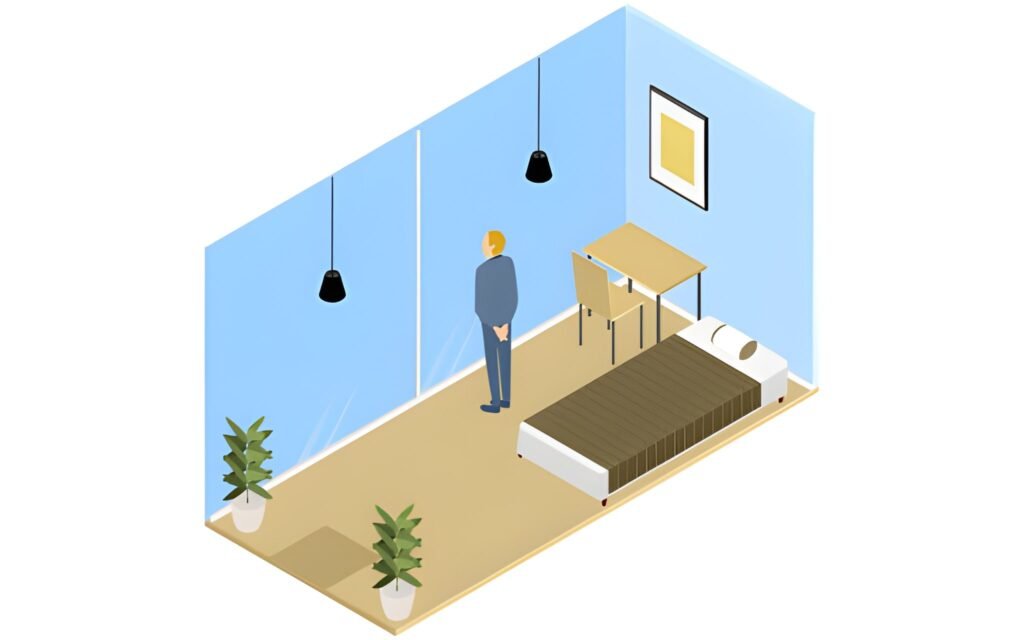
Minimum room sizes are a cornerstone of HMO licensing regulations across the UK, designed to prevent overcrowding and ensure a basic standard of living for tenants. While the principle is national, the specific dimensions are set at the local authority level, creating a complex patchwork of rules that landlords must navigate precisely. Failure to comply is not a minor infraction; it is a direct breach of licence conditions that can lead to licence revocation, prosecution, and financial penalties.
The National Baseline in England
Since October 2018, a mandatory national minimum room size has been in force for licensed HMOs in England. This sets a firm baseline below which no local authority can go.
- A room used for sleeping by one person aged 10 or over: Must be no smaller than 6.51 square metres.
- A room used for sleeping by two persons aged 10 or over: Must be no smaller than 10.22 square metres.
These measurements are for the usable floor area. This means the space a tenant can actually use, calculated from the internal finished faces of the walls. It excludes any area where the ceiling height is less than 1.5 metres, such as within the slope of a dormer roof.
Local Authority Variations and Stricter Rules
While the national minimums provide a floor, many local councils have implemented their own, more stringent space standards through their HMO licensing conditions. It is the landlord’s responsibility to know and adhere to the specific rules of their property’s local authority.
Common local variations include:
- Larger Minimum Sizes: Some councils require single rooms to be 7.0, 8.0, or even 9.0 square metres. Double rooms may be required to be 12.0 or 15.0 square metres.
- Minimum Floor Dimensions: A council may stipulate that a room must be at least 2.2 metres wide in any dimension to ensure it can accommodate furniture practically.
- Room Usage Restrictions: A room measuring between 4.0 and 6.5 square metres may be classified as only suitable for use as a study or for a child under 10, and cannot be let to a single adult occupant.
The Legal and Practical Implications
Adhering to minimum room sizes is a non-negotiable aspect of the HMO licence. The licence will explicitly state the permitted number of occupants for each room. Letting a room to more people than its size permits is a breach of the licence.
Consequences of Breach:
- The local authority can revoke the HMO licence.
- They can issue a Civil Penalty of up to £30,000.
- They can prosecute, leading to an unlimited fine.
- Tenants can apply for a Rent Repayment Order (RRO) to reclaim up to 12 months of rent.
How to Measure a Room Correctly
Accurate measurement is critical. The standard methodology is as follows:
- Measure the Gross Internal Area: Measure the length and width of the room at floor level, between the internal finished surfaces of the walls. Multiply to get the area in square metres.
- Deduct Non-Usable Space: Identify any areas where the ceiling height is less than 1.5 metres. Measure and deduct these areas from the total.
- Deduct Built-in Obstructions: Permanently fixed obstructions, such as a large, non-removable chimney breast, are typically deducted. Freestanding or fitted furniture (wardrobes, cupboards) is usually included in the calculation, but some councils may have specific rules, so checking is essential.
Illustrative Calculation for an L-Shaped Room:
Imagine a room with a main area of 3m x 2.5m and a small alcove of 1.5m x 1m, but the ceiling in the alcove is only 1.4m high.
- Main Area: 3.0 \times 2.5 = 7.5 \text{m}²
- Alcove Area: 1.5 \times 1.0 = 1.5 \text{m}²
- Gross Internal Area: 7.5 + 1.5 = 9.0 \text{m}²
- Deduct Non-Usable Space: The entire 1.5m² alcove is deducted due to low headroom.
- Usable Floor Area: 9.0 - 1.5 = 7.5 \text{m}²
This room complies with the national minimum for a single occupant (6.51m²) but may not comply with a local standard requiring 8.0m².
Actionable Steps for Landlords
- Identify Your Local Rules: Before purchasing a property or converting an existing one, contact the local HMO licensing department to obtain their specific space standards in writing.
- Measure Professionally: Before submitting a licence application, have all rooms professionally measured, preferably by a surveyor, to produce accurate floor plans. This pre-empts disputes during the council’s inspection.
- Be Cautious with Conversions: Be extremely wary of converting reception rooms or other small spaces into bedrooms. What seems like a large room may fail the minimum size test once obstructions are accounted for.
- Document Everything: Keep detailed floor plans and measurement calculations in your compliance file as evidence of your due diligence.
Conclusion: A Foundational Standard
Minimum room sizes are a fundamental aspect of providing safe and legal HMO accommodation. They are not a matter for estimation or guesswork. In an era of heightened enforcement, relying on the national minimums alone is insufficient. A landlord’s due diligence must include a precise understanding of their local council’s specific regulations and a rigorous approach to measuring and certifying their property’s compliance. Investing in this clarity from the outset prevents costly and reputationally damaging enforcement action down the line, ensuring the property is not only a profitable asset but also a lawful and humane home.