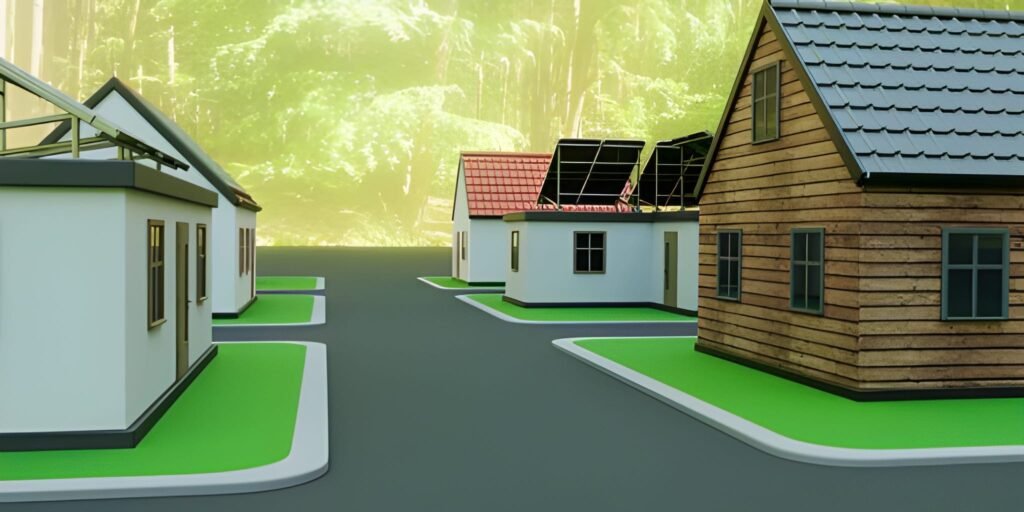
A self-sustaining off-grid housing scheme represents the pinnacle of sustainable living, evolving from a single autonomous dwelling to a collaborative, resilient community. This is not merely a collection of homes without utility hookups; it is a consciously designed human-scale settlement that functions as an integrated, closed-loop ecosystem. The goal is to achieve a high degree of sovereignty in energy, water, and food production while fostering a robust social and economic fabric. Such a scheme, which we might call a “Sovereign Steading,” is engineered for long-term resilience, capable of weathering external disruptions in supply chains, energy grids, and climate instability through its own sophisticated, localized systems.
The Foundational Pillars of the Scheme
The success of the steading rests on five interdependent pillars, each managed at the community level while allowing for individual household autonomy.
1. Autonomous Energy Infrastructure
The scheme’s energy system is a decentralized, smart microgrid designed for reliability and surplus.
- Mixed Renewable Generation: The scheme leverages a combination of solar photovoltaic arrays, small-scale wind turbines, and potentially micro-hydro if a water source is available. This diversity ensures continuous generation; when solar production dips on cloudy days, wind often increases.
- Centralized Biomass Energy: A communal woodlot, managed through sustainable coppicing, provides fuel for a central biomass boiler. This system distributes heat through a district heating network to all homes, providing a robust, low-tech heating solution for harsh winters that minimizes the drain on individual household battery systems.
- Smart Microgrid with Vehicle-to-Grid (V2G): The community operates its own intelligent electrical grid. Surplus energy from one home’s solar array can be directed to a neighbor or to a central community battery bank. Furthermore, the community’s collective electric vehicle fleet is integrated as a massive, distributed storage asset. During a period of low generation, energy from car batteries can be fed back into the microgrid to power essential community infrastructure.
2. Closed-Loop Water and Nutrient Management
Water is treated as the most precious resource, managed in a multi-loop system that mimics natural hydrological cycles.
- Rainwater Harvesting at Scale: Every roof is a catchment surface. Water is channeled not only to individual household cisterns but also to large, communal underground storage tanks, providing a strategic reserve for drought periods.
- Phased Water Treatment: The scheme employs a “cascading” water use philosophy. Potable water, treated with UV and ceramic filters, is used for drinking and cooking. Greywater from showers and sinks is filtered through constructed wetlands and reused for toilet flushing and subsurface garden irrigation.
- Communal Living Machine for Blackwater: Instead of individual septic systems, the community invests in a centralized “Living Machine” or sequencing batch reactor. This biological treatment system, often housed within a greenhouse, uses bacteria, algae, and plants to treat blackwater to a high standard, producing effluent safe for irrigating non-food crops or replenishing groundwater. The resulting nutrient-rich sludge is safely composted and used in designated areas.
3. Regenerative Food Production and Land Stewardship
The land is the primary source of sustenance and is managed according to agroecology and permaculture principles.
- Zoned Land Use: The property is divided into use-specific zones.
- Zone 1: Home Gardens: Individual plots for each household’s daily vegetables and herbs.
- Zone 2: Communal Orchards and Crops: Larger fields for staple crops (e.g., potatoes, grains, squash) and orchards managed collectively, with harvests shared or bartered.
- Zone 3: Pasture and Agroforestry: Land for grazing small livestock (goats, chickens) integrated with nut and fruit trees (silvopasture).
- Zone 4: Managed Woodland: The source for timber, firewood, and foraging, managed as a continuous-cover forest.
- Integrated Nutrient Cycling: A community composting facility processes all organic waste—household scraps, crop residues, and manure—into rich humus to feed the soil, closing the nutrient loop entirely within the property boundaries.
4. Circular Economy and Shared Resources
The scheme cultivates economic resilience by minimizing external dependencies and maximizing internal resourcefulness.
- The Community Trust and Tool Library: A central trust owns the land and core infrastructure. A shared facility houses a comprehensive library of tools, from tractors and woodshops to canning equipment, which residents can access, eliminating redundant ownership.
- Skill-Based Barter and Micro-Enterprise: The community actively maps and trades skills. A resident electrician might trade services with a carpenter, a baker, and a mechanic. Surplus produce, preserved goods, and handcrafted items are bartered or sold within the community, fostering a localized economy.
- Waste as a Resource: Every output is considered a potential input. Wood ash from stoves is used to balance soil pH. Waste cardboard and paper are shredded for compost or used in sheet mulching. Plastic and metal are meticulously sorted for periodic bulk sale to recyclers, turning a cost center into a minor revenue stream.
Governance and Social Cohesion: The Human Element
The technical systems are futile without a robust social contract. The Sovereign Steading is governed by a participatory model, such as sociocracy, which uses consent-based decision-making within a circle structure (e.g., Energy Circle, Food Circle, Social Circle). Regular community meals, shared workdays, and skill-sharing workshops are not optional extras but essential infrastructure for building trust, resolving conflicts, and ensuring the long-term vitality of the community.
The Financial and Logistical Calculus
Establishing such a scheme requires significant upfront capital. The cost can be modeled as:
\text{Total Capital Cost} = C_{\text{land}} + C_{\text{infrastructure}} + C_{\text{construction}}Where infrastructure cost C_{\text{infrastructure}} includes the microgrid, water systems, and road access. However, the ongoing operational costs are drastically lower than conventional living. The annual financial outflow is reduced to:
\text{Annual Cost} = \text{Property Tax} + \text{Insurance} + \text{Replacement Reserves} + \text{Minor External Purchases}The elimination of utility bills, a significant portion of most household budgets, and the production of one’s own food, create a powerful economic buffer.
A self-sustaining off-grid housing scheme is therefore the ultimate expression of applied ecology and community resilience. It is a deliberate departure from the fragility of globalized systems and a step towards a future where communities are not just places to live, but active, adaptive, and sovereign partners in the stewardship of their own destiny.