The concept of an eco home has evolved from a structure that simply minimizes harm to one that actively improves its environment and the lives of its inhabitants. A cutting-edge eco home is no longer defined by a single technology, like solar panels, but by the seamless integration of biology, technology, and data into a single, responsive, and regenerative living system. It is a “living laboratory” that generates its own energy, manages its own water and waste, adapts to its occupants’ needs, and contributes positively to the local ecosystem. This new paradigm represents a fundamental shift from sustainability—meeting our needs without compromising the future—to regeneration—leaving the environment better than we found it.
The Core Pillars of a Cutting-Edge Eco Home
1. Biophilic and Biomorphic Design: The Home as an Ecosystem
This goes beyond placing a few houseplants. It involves designing the home to mimic natural forms (biomorphism) and fostering a deep, intrinsic connection between the inhabitants and nature.
- Living Walls and Bio-Filters: Interior walls are not just painted; they are alive. Vertical gardens and “bio-walls” use carefully selected plants to actively filter volatile organic compounds (VOCs) from the air, regulate humidity, and produce oxygen. The home’s air purification is handled not by a machine, but by a living ecosystem.
- Mycelium Insulation and Structures: The structural and insulating components of the home are grown, not manufactured. Mycelium—the root structure of mushrooms—is cultivated into solid, strong, and fully compostable panels for insulation and even non-load-bearing walls. At the end of its life, the wall can be composted, completing a natural cycle.
- Dynamic, Nature-Responsive Facades: The building’s exterior is not static. It might feature a “breathing” facade with operable shingles that open and close in response to sun and wind, or panels coated with a hydrogel that absorbs moisture on cool nights and releases it through evaporation during hot days, providing a passive cooling effect.
2. Closed-Loop Metabolic Systems: Water, Waste, and Nutrients
The home operates like a natural organism with a circular metabolism, where outputs become inputs.
- Atmospheric Water Generation: Beyond rainwater harvesting, the home can extract pure, drinkable water directly from the humidity in the air using solar-powered atmospheric water generators, ensuring water security even in arid climates.
- Blackwater Recycling with Living Machines: Instead of sending wastewater to a municipal treatment plant, the home treats it on-site using a “Living Machine.” This is an engineered wetland within a greenhouse, where a series of aerobic and anaerobic tanks, filled with specific plants, bacteria, and organisms, treat the water to a standard pure enough for garden irrigation and toilet flushing. The system is beautiful, odor-free, and teeming with life.
- Anaerobic Digestion of Waste: All organic kitchen waste is fed into a small-scale anaerobic digester. This sealed, oxygen-free system breaks down the waste, producing two valuable resources: biogas, which can be used for cooking, and a nutrient-rich liquid fertilizer for the garden.
3. Intelligent and Adaptive Energy Management
The home is not just efficient; it is a smart, interactive node in a decentralized energy grid.
- Integrated Solar Skin: Photovoltaics are no longer an add-on panel but the very fabric of the building. Solar cells are embedded directly into roof shingles, glass facades, and even windows as transparent films, turning the entire envelope into a power generator.
- AI-Optimized Home Energy Management (HEM): A central AI system acts as the home’s “brain.” It learns the occupants’ patterns and the home’s thermal performance. It makes real-time decisions, such as pre-cooling the thermal mass floors before a heatwave using cheap solar power, or selling stored battery energy back to the grid during peak demand when the price is highest. The home’s equation for cost is dynamic: \text{Net Cost} = \text{Grid Import Cost} - \text{Grid Export Revenue}, and the AI works to minimize this value, often achieving a net-negative result.
- Vehicle-to-Grid (V2G) Integration: The family’s electric vehicle is not just a mode of transport; it is a massive mobile battery. During a power outage or peak grid demand, the car can power the home. When the home’s solar array is producing excess energy, it can charge the car, creating a resilient and flexible personal energy ecosystem.
4. Hyper-Performance and Health-Centric Fabric
The building envelope is a highly tuned filter between the interior and exterior environments.
- Phase-Changing Materials (PCMs): Wallboards and plasters are infused with micro-encapsulated PCMs. These materials absorb excess heat as they melt (changing from solid to liquid) at a specific temperature (e.g., 23°C), preventing the space from overheating. They release the stored heat as they solidify when temperatures drop, smoothing out daily temperature swings far more effectively than standard thermal mass.
- Smart, Self-Ventilating Windows: Windows are made from dynamic glass that can tint electronically to control solar gain. Microscopic pores can open to allow fresh air to diffuse in while maintaining the window’s insulation and security, working in concert with the MVHR system.
- Holistic Material Health: Every material is vetted not just for its embodied carbon, but for its impact on indoor air quality. Walls are finished with clay plasters that absorb toxins and regulate humidity, and all wood is finished with natural, non-off-gassing oils. The home actively contributes to the physiological well-being of its occupants.
A Vision in Practice: The “Bio-Integrated Residence”
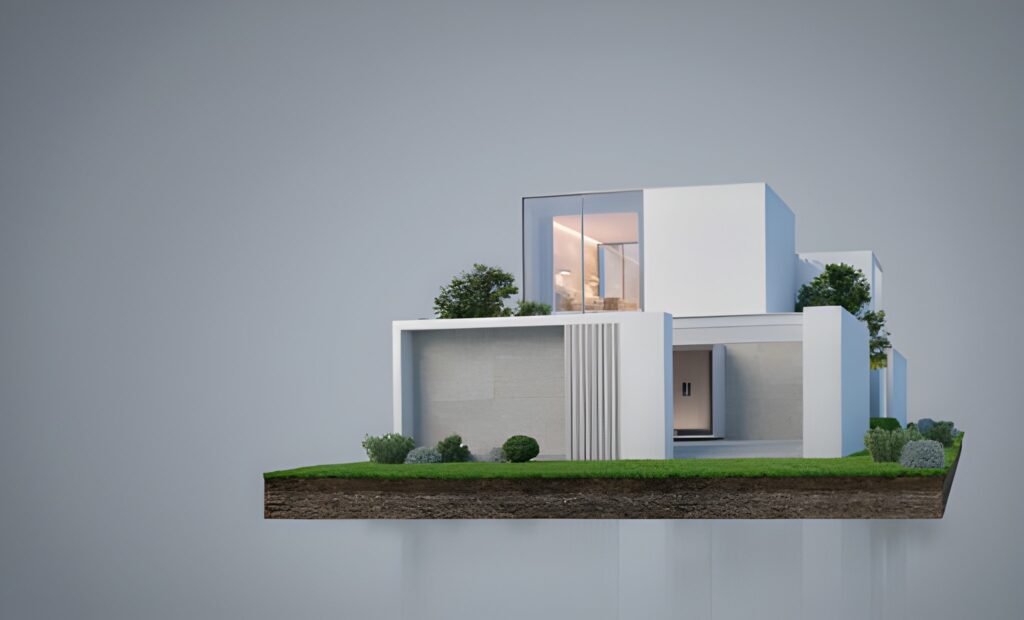
Imagine a home that from the outside appears as a graceful, modern structure nestled into a lush landscape. Its roof is a seamless, dark surface generating power, and one wall is a vibrant tapestry of greenery. Inside, the air is noticeably fresh, with a subtle, earthy scent. A digital display in the hallway shows real-time data: “Energy Independence: 112%. Water Sourced: 65% from atmosphere. Indoor Air Quality: Optimal.”
The central AI has already learned that the homeowners host a gathering every Saturday afternoon. In anticipation, it has pre-cooled the polished concrete floors using the morning’s solar energy and has notified the occupants that the anaerobic digester has produced enough biogas for two hours of stove use for the evening’s meal.
This is the cutting-edge eco home: a synergistic blend of nature’s intelligence and human innovation. It is not a passive shelter but an active partner in creating a healthier, more resilient, and regenerative future. It represents the pinnacle of where we can live—not just on the planet, but with it.