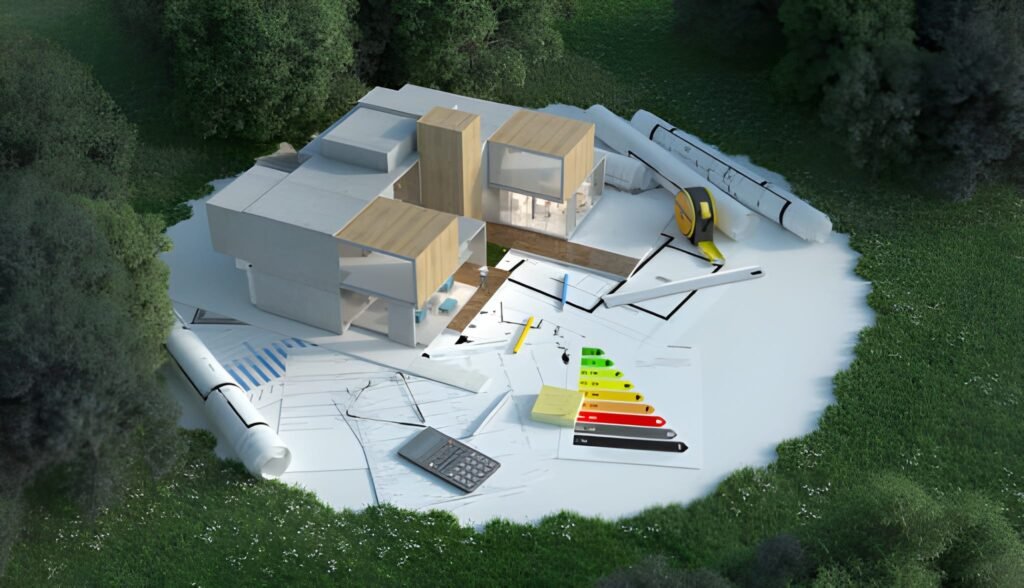
Designing a five-bedroom sustainable house presents a unique and rewarding challenge: scaling the principles of eco-conscious living to accommodate a larger family or multi-generational living without sacrificing efficiency, comfort, or its core environmental ethos. The goal is to move beyond simply adding rooms and instead create an integrated system where the architecture, orientation, materials, and technology work in concert to minimise the building’s footprint while maximising the health and well-being of its inhabitants. A successful design for a home of this size is not defined by square footage alone, but by its intelligent layout, its relationship to the sun and wind, and its ability to generate more resources than it consumes over its lifecycle.
Foundational Design Principle: The Zoned and Elongated Floor Plan
For a five-bedroom home, a sprawling, complex shape is the enemy of efficiency. The most effective design employs a zoned, elongated floor plan, often arranged in a “T,” “H,” or “L” shape. This configuration is paramount for several reasons:
- Solar Optimisation: The long axis of the house should run east-west, allowing the primary living spaces (e.g., kitchen, dining, living room) to be positioned along the north-facing side (in the Northern Hemisphere). This maximises exposure to the low-lying winter sun for passive solar heating. The elongated form creates a larger north-facing façade, perfect for capturing solar energy.
- Thermal Zoning: The home is divided into distinct zones based on temperature needs. The “day zone” (living areas) occupies the warm, north side. The “night zone” (bedrooms) is placed on the cooler, south side, promoting better sleep. Service areas like bathrooms, laundries, and pantries are positioned on the east and west to act as thermal buffers, shielding the main living and sleeping areas from temperature extremes.
- Cross-Ventilation: The elongated plan, with windows on both the north and south facades, facilitates excellent cross-ventilation. Strategically placed windows allow cool breezes to flow through the entire home, passively cooling it during warmer months and reducing reliance on air conditioning.
A Conceptual Design: The “Family H-House”
A highly effective design for a 5-bedroom sustainable home is the “H-house.” Imagine two parallel wings connected by a central, glazed link.
- North Wing (The Day Wing): This single-storey wing houses the open-plan kitchen, dining, and living area. It features a full-height, north-facing glazed wall that opens onto a covered veranda and the garden. The roof of this wing is a single plane, ideally angled perfectly for a large solar photovoltaic (PV) array.
- South Wing (The Night Wing): This two-storey wing contains the private spaces. The ground floor hosts the master bedroom suite, a home office/study, and a utility room. The upper floor contains four additional bedrooms and two bathrooms. By stacking bedrooms, the building’s footprint is reduced, preserving more of the natural site.
- The Central Link (The Heart): This is a stunning, double-height space that connects the two wings. It houses the entrance and a central staircase. Designed as a “solar chimney,” it features high-level clerestory windows that open automatically to exhaust hot air, drawing cool air through the rest of the house. This space is flooded with natural light, reducing the need for artificial lighting during the day.
Key Sustainable Systems and Specifications
1. Super-Insulated and Airtight Envelope
The entire building shell—walls, roof, and floor—must be super-insulated, far exceeding standard building regulations. A continuous layer of high-performance insulation (such as wood fibre or rigid cork) is combined with an meticulously detailed airtight membrane. This is the single most important investment, ensuring that the home requires minimal energy for heating and cooling. All windows are triple-glazed with low-emissivity coatings and filled with argon gas.
2. Advanced Mechanical Systems
- Mechanical Ventilation with Heat Recovery (MVHR): In an airtight home of this size, an MVHR system is non-negotiable. It continuously extracts stale, moist air from kitchens and bathrooms and supplies fresh, filtered air to living rooms and bedrooms. The heat exchanger recovers up to 90\% of the temperature from the exhaust air, drastically reducing heating costs.
- Air-Source Heat Pump: This all-electric system provides highly efficient space heating and domestic hot water. It works by extracting ambient heat from the outside air, even in cold weather.
- Renewable Energy Generation: The large, north-facing roof of the Day Wing is designed to accommodate a 8-12\text{kW} solar array. This size is calculated to meet the annual electricity demand of the heat pump, MVHR, lighting, and appliances for a family of five to seven.
3. Water and Material Strategy
- Rainwater Harvesting: A large underground tank collects rainwater from all roofs. This water is filtered and used for toilet flushing, laundry, and garden irrigation, potentially reducing mains water use by 50\%.
- Low-Embodied Carbon Materials: The structure prioritises materials that store carbon, such as Cross-Laminated Timber (CLT) for the floors and walls, and hempcrete for infill walls. Where possible, materials are sourced locally and are naturally derived (stone, clay plaster, lime renders).
Spatial Layout and Room Functions
- Ground Floor (Day Wing & Part of Night Wing):
- Open-Plan Living Area: A spacious, light-filled zone with a polished concrete floor for thermal mass.
- Master Suite: A private retreat on the ground floor with an en-suite bathroom and walk-in robe.
- Study/Home Office: A quiet room for work, positioned away from the main living area.
- Utility/Mudroom: A dedicated space for laundry and storing outdoor gear, preventing dirt from entering the main house.
- First Floor (Night Wing):
- Bedrooms 2, 3, 4, & 5: Four well-proportioned bedrooms, all with built-in storage to minimise clutter. South-facing rooms have smaller windows to limit heat loss, with high-level clerestory windows for light and ventilation.
- Two Bathrooms: Strategically placed to serve the four upper-floor bedrooms efficiently.
The Financial and Ecological Calculus
The initial investment in a 5-bedroom sustainable house is typically 10-20\% higher than a conventional build of the same size. However, the operational costs are a fraction of the norm. The annual energy cost for heating, cooling, and hot water can be reduced by over 70\%. When the solar PV system is factored in, the home can achieve net-zero energy status, meaning its annual energy production equals or exceeds its consumption.
This design philosophy transforms a large family home from a heavy consumer of resources into a resilient, healthy, and productive asset. It demonstrates that sustainability and spacious living are not mutually exclusive but can be synergistically combined to create a legacy home that nurtures both its inhabitants and the planet.